

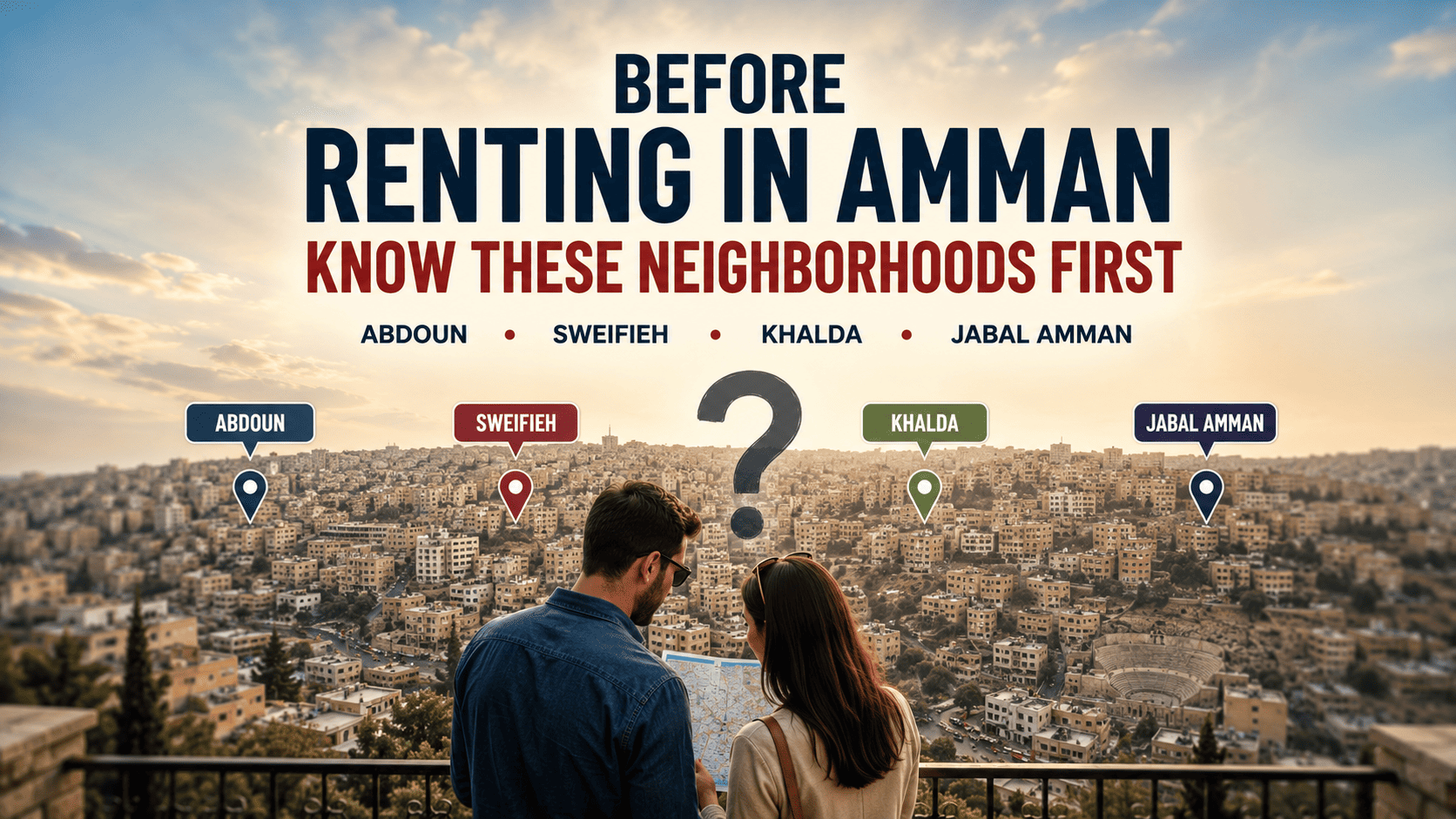

Before Renting in Amman, Spend 10 Minutes Getting to Know These Neighborhoods

One of the most common mistakes people make when searching for an apartment in Amman is focusing entirely on the property itself.
They compare rental prices, browse photos, check how many bedrooms are available, and ask whether the apartment is furnished or unfurnished. Those details matter, of course. But after years of watching renters move across the city, one thing becomes clear: people rarely regret choosing the wrong apartment. They regret choosing the wrong neighborhood.
The apartment is where you live. The neighborhood is what you experience every day.
It determines how long your commute feels. It affects where you buy groceries, where you meet friends, how easily guests can visit, how much traffic you deal with, and even how likely you are to renew your lease when the contract ends.
For someone moving to Amman for the first time, the city can appear surprisingly straightforward. On a map, many neighborhoods seem close together. In reality, daily life can feel very different depending on where you decide to live.
That is why experienced renters often spend more time researching neighborhoods than apartments.
Before signing a lease, it helps to understand not only what an apartment offers but also what the surrounding area will look like once everyday life begins.
Why the Same Budget Can Produce Completely Different Results
Let's imagine two renters with the same monthly budget.
Both are looking for an apartment in Amman.
Both want a secure building, reliable internet, and convenient access to daily services.
Yet they may end up living in completely different neighborhoods.
One person may choose Abdoun because they value proximity to international schools, embassies, and modern residential developments.
Another may choose Khalda because they prefer a larger apartment and don't mind being slightly farther from some commercial districts.
Neither choice is automatically right or wrong.
The difference comes from priorities.
Many first-time renters assume that the "best" neighborhood is simply the most expensive one. In practice, the best neighborhood is usually the one that matches the way you actually live.
A family with children often evaluates neighborhoods differently from a young professional. Someone working remotely has different priorities than someone driving across the city every morning.
Understanding these differences before renting can prevent expensive mistakes later.
Abdoun: Why It Continues to Attract Newcomers
If someone arrives in Amman without knowing much about the city, there is a good chance they will hear the name Abdoun within their first few days.
For years, Abdoun has been one of the most recognized residential districts in the capital.
Many embassies, international organizations, schools, restaurants, and cafés are located nearby. As a result, the neighborhood has become particularly popular among diplomats, expatriates, business professionals, and families relocating from abroad.
A significant part of Abdoun's appeal comes from familiarity.
Many newcomers feel comfortable there because the area offers amenities and services that are easy to access. Apartment buildings are often newer, roads are generally well maintained, and the neighborhood has developed a reputation for being one of the city's most desirable addresses.
That said, renters should understand what they are paying for.
A portion of the rental premium attached to Abdoun comes from its reputation and location.
For some people, that premium makes complete sense.
For others, especially renters who prioritize apartment size over neighborhood prestige, other areas may provide better value.
One reason experienced renters rarely recommend choosing a neighborhood solely based on reputation is that daily life often looks different from initial expectations.
An apartment that feels perfect during a weekend viewing may not feel quite as perfect after six months of commuting.
That is why it is worth spending time in the neighborhood before making a decision.
Sweifieh: Where Convenience Often Becomes the Selling Point
If Abdoun is associated with prestige, Sweifieh is often associated with convenience.
People who live in Sweifieh rarely need to travel far for everyday necessities.
Shopping centers, cafés, restaurants, gyms, banks, offices, and service providers are all woven into the neighborhood.
For busy professionals, that convenience becomes a major advantage.
Instead of spending additional time driving across the city, residents often find many of their daily needs within a relatively short distance.
The neighborhood also attracts younger renters who enjoy being close to commercial activity.
However, convenience has trade-offs.
The same activity that makes Sweifieh attractive can make it feel busier than some purely residential districts.
For some renters, that energy is part of the appeal.
Others eventually decide they prefer quieter surroundings.
This is why viewing a neighborhood at different times of day can be valuable.
An area that feels calm at 10 a.m. may feel entirely different during evening traffic hours.
Khalda: The Neighborhood People Appreciate More Over Time
One of the most interesting patterns among long-term residents is how often Khalda enters the conversation.
Newcomers tend to focus on neighborhoods they have heard about before arriving in Jordan.
People who have lived in Amman for several years often bring up Khalda.
The reason is relatively simple.
Khalda tends to offer a practical balance between cost, space, and convenience.
Many renters discover they can secure larger apartments compared to some of the city's higher-priced districts while still maintaining access to schools, healthcare facilities, supermarkets, restaurants, and daily services.
For families, this balance can be particularly attractive.
Parents often find that larger living spaces become more important over time than a prestigious address.
The neighborhood may not receive the same international attention as Abdoun, but many residents consider it one of the city's most practical places to live.
In real estate, practicality often becomes more valuable after the excitement of relocating fades.
Jabal Amman: A Different Side of the City
Every city has neighborhoods that feel distinct from the rest.
In Amman, Jabal Amman occupies that position for many residents.
The area offers a character that is difficult to replicate elsewhere.
Historic buildings, older residential streets, cultural institutions, independent cafés, and long-established businesses contribute to an atmosphere that feels different from newer developments.
People are often drawn to Jabal Amman because it feels lived-in rather than recently built.
The neighborhood appeals to residents who value atmosphere and location as much as modern amenities.
At the same time, renters should understand that older neighborhoods sometimes come with compromises.
Apartment layouts can vary considerably.
Building ages differ.
Parking situations may not always match what renters expect from newer developments.
Yet many residents willingly accept these trade-offs because they appreciate the character of the area.
For the right renter, that character becomes a major advantage rather than a compromise.
Deir Ghbar: Frequently Recommended for Families
When families ask for neighborhood recommendations, Deir Ghbar often appears near the top of the list.
The area has earned a reputation for being residential, comfortable, and well suited to family life.
Compared to busier commercial districts, the neighborhood generally feels more focused on residential living.
Many apartment buildings are designed with families in mind, and larger units are relatively common.
Schools, healthcare facilities, supermarkets, and essential services are all accessible, making everyday routines easier to manage.
Parents often discover that convenience looks different after having children.
A shorter drive to school or easier access to daily services can quickly become more valuable than living near restaurants or nightlife.
This shift in priorities explains why many families eventually focus their apartment search on neighborhoods such as Deir Ghbar.
Dabouq: When Space Matters More Than Activity
Not everyone wants to live close to the busiest parts of the city.
Some renters prioritize privacy, larger homes, and quieter surroundings.
Dabouq frequently attracts those renters.
The neighborhood offers a more residential atmosphere than many central districts.
Properties often provide larger living spaces, and many residents appreciate the sense of separation from the city's busiest commercial zones.
For families and professionals seeking a quieter environment, this can be appealing.
However, quieter neighborhoods sometimes require additional driving for work, shopping, dining, or entertainment.
Whether that trade-off makes sense depends entirely on personal preferences.
Some residents value activity.
Others value peace.
Neither choice is inherently better.
What Online Listings Never Show
Property listings are designed to highlight apartments.
They showcase kitchens, living rooms, bedrooms, balconies, and views.
What they cannot show is how the neighborhood functions on an ordinary weekday.
Photos do not reveal rush-hour traffic.
They do not show how easy parking is after sunset.
They do not tell you whether your preferred supermarket is five minutes away or twenty.
They do not reveal whether nearby roads become congested during school pickup hours.
And they certainly do not show what the neighborhood feels like after living there for six months.
These practical realities often influence long-term satisfaction far more than apartment features.
A slightly smaller apartment in the right location frequently proves to be a better choice than a larger apartment in the wrong one.
Why Some Renters Move Again After Their First Lease
One of the biggest surprises for newcomers is how often people change neighborhoods after their first year in Amman.
This usually has nothing to do with problems.
The apartment may be perfectly fine.
The landlord may be excellent.
The building may meet every expectation.
Yet people still move.
Why?
Because experience changes priorities.
Someone who initially chose a neighborhood based on recommendations may later realize they care more about space.
Another renter may discover that reducing commute times improves daily life more than expected.
Families may reassess their needs after becoming familiar with schools and services.
Professionals may decide that convenience outweighs prestige.
Living in a city teaches lessons that maps cannot.
That is why neighborhood selection deserves as much attention as apartment selection.
A Few Questions Worth Asking Before Signing a Lease
Before committing to an apartment, take a moment to consider a few practical questions.
How often will you commute?
Where will you shop for groceries?
Do you prefer activity or quiet surroundings?
How important is parking?
Will children need access to schools nearby?
How often do you host guests?
Do you spend weekends at home or outside?
The answers may point you toward a neighborhood you had not originally considered.
And in many cases, those answers are more valuable than comparing apartment photos.
The Neighborhood Often Determines Whether You'll Stay
Most people begin apartment hunting by asking which apartment is best.
Experienced renters often ask a different question.
Which neighborhood feels right?
That distinction matters.
Apartments can be renovated.
Furniture can be replaced.
Walls can be repainted.
The neighborhood, however, remains largely the same.
It shapes your routine every single day.
When renters look back on successful housing decisions, they often remember the neighborhood first and the apartment second.
The coffee shop they visited regularly.
The short drive to work.
The convenience of nearby services.
The feeling of being comfortable in the area.
Those experiences are difficult to measure when browsing listings online, but they often determine whether someone stays for one year or five.
Before renting in Amman, spend a little time getting to know the neighborhoods you are considering. Walk the streets. Visit at different times of day. Observe how people live there. The apartment may be where you sleep, but the neighborhood is where your daily life unfolds.
Also Read: Furnished Apartment for Rent in Amman With Balcony and Skyline Views
News insight
 Oct 09, 2026
 Where to Live in Amman, Jordan: Weibdeh, Jabal Amman and Abdoun
Explore life in Jabal Al Weibdeh, Jabal Amman, and Abdoun, from traditional stone homes and café str...
 Oct 02, 2026
 Is 6th Circle a Good Place to Live in Amman?
Is 6th Circle right for your next apartment in Amman? Compare rent, traffic, nearby areas, restauran...
 Sep 25, 2026
 Rainbow Street Amman: The Old Heart of Jabal Amman
Rainbow Street Amman runs through historic Jabal Amman, with old stone houses, cafés, galleries, hil...